

BRYAN ROBERTSON, Holistic LGBTQ+ TRAUMA Therapist in PASADENA, CA
You’ve Earned Everything the World Told You To Want. So Why Does It Still Feel Like Survival?
LGBTQ+ Affirming Holistic Trauma Therapy for High-Achieving Professionals in Pasadena & Throughout California
You’ve built the career. You show up. You deliver. And somewhere in the gap between the life you’ve constructed and the life you actually feel — there’s a quiet exhaustion that success was supposed to fix by now.
Maybe you’re LGBTQ+ and have spent years learning to be palatable — code-switching in boardrooms, performing certainty in relationships, and editing yourself in spaces that never quite felt safe. Maybe the anxiety, the overworking, the 3 AM spiral isn’t about ambition. Maybe it’s about survival patterns that were once brilliant adaptations to a world that asked you to be less than you are.
I’m Bryan. I’m a queer, non-binary, neurodivergent therapist — and I understand this terrain from the inside. At Holistic Trauma Therapy, I work with high-achieving LGBTQ+ individuals, men, and neurodivergent adults ready to stop performing wholeness and start inhabiting it.
If you’ve been searching for a therapist who truly gets you — your story, your identity, your trauma — you can stop looking.
WHO I WORK WITH
You Might be in the Right Place if….

You’re a high-achieving professional, executive, or entrepreneur who looks capable from every angle — but privately feels one trigger away from unraveling.
You identify as LGBTQ+ and carry the accumulated weight of identity-based wounds: rejection, religious trauma, code-switching, or the pressure to shrink yourself for acceptance.
You’re neurodivergent and exhausted by masking — at work, in relationships, and even in therapy spaces that weren’t designed for the way your mind works.
You’ve tried talk therapy before, but talking about it wasn’t enough. The anxiety is still in your body. The patterns still run the show.
You’re dealing with addiction, compulsive behaviors, or overworking not because you’re weak — but because your nervous system found a way to cope, and now it’s costing you.
You want healing that honors all of you: your identity, your ambition, your spirituality, your complexity.
WHY MOST THERAPY MISSES HIGH-ACHIEVING LGBTQ+ CLIENTS
Most Therapy Wasn’t Built For You. This One Is.
High-achieving LGBTQ+ professionals face a specific and often invisible burden: the double performance. You perform success for a world that measures your worth in output. You perform identity in spaces that expect you to be either less queer or less professional. And somewhere in the middle of all that performing, the authentic you gets very, very tired.
Standard talk therapy often misses this. It treats the symptom — the anxiety, the relationship pattern, the substance use — without asking the deeper question: what survival story is this behavior telling?
At Holistic Trauma Therapy, we work at the root. Using somatic therapy, Internal Family Systems (parts work), depth psychology, and trauma-informed approaches, we trace the path from your present-day patterns back to the original wounds — including the ones that came with growing up queer, neurodivergent, or different in a world that often punished those differences.
You don’t have to choose between being taken seriously as a professional and being fully seen as a queer human. In this space, you get to be both — unedited.
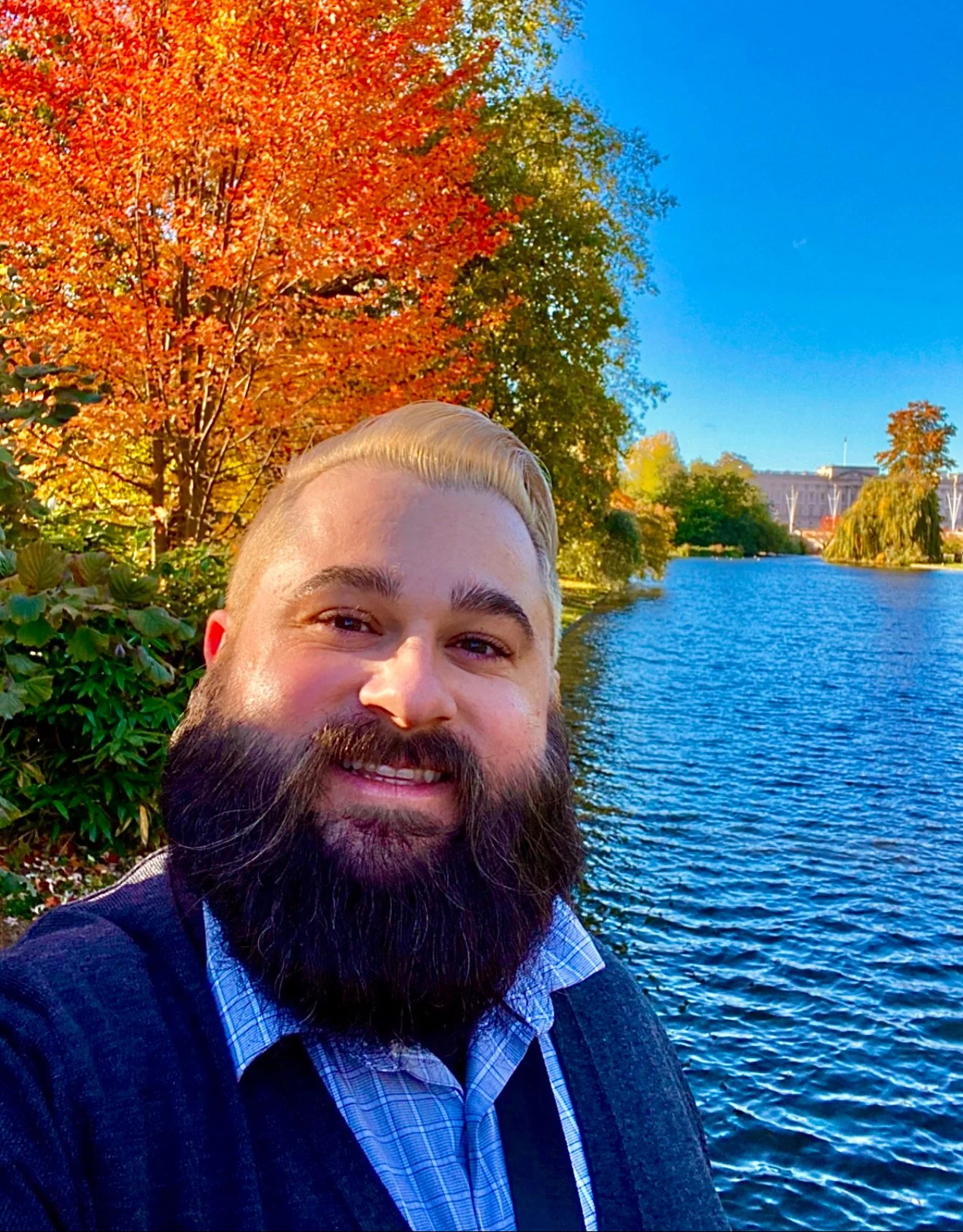
Hi, I’m BRYAN.
I believe one-size-fits-all therapy rarely works because real transformation requires looking at the entire story of who you are. Rather than just treating symptoms, my approach focuses on healing at the root to create lasting change.
I came to this work through my own journey of learning that the parts of me the world called ‘too much’ or ‘not enough’ were actually the most essential parts of my story. As a queer, non-binary, neurodivergent person, I know what it feels like to move through systems and spaces that weren’t designed for you — and to learn, over time, that the mask has a cost.
My clinical training is grounded in somatic therapy, depth psychology, and parts work. I bring this to bear on the specific intersections my clients navigate: identity-based trauma, high-functioning anxiety, addiction as nervous system regulation, religious trauma, and the relational complexity that comes with being LGBTQ+ in a world still catching up.
Before becoming a therapist, I worked in corporate America giving me a deep understanding of the internal landscape of high-performance environments: the pressure, the code-switching, the way achievement can become its own kind of hiding. I know the difference between thriving and performing. I’m here to help you find the former.
My approach is holistic and collaborative. I believe in looking at the entire story of who you are — your identity, your history, your nervous system, your relationships — and finding the thread that, once followed, changes everything.
I practice under the clinical supervision of Dr. Michael Grey, PsyD, LMFT (136636), and the training of Seema Sharma, SEP, LMFT — Chief Traumatologist and founder of Holistic Trauma Therapy.
REACH OUT TODAY TO SCHEDULE A CONSULTATION, AND WE CAN BEGIN REWRITING YOUR STORY TOGETHER.
Registered Associate Marriage & Family Therapist (157666)
Registered Associate Professional Clinical Counselor (20019)
My background & training
I combine evidence-based trauma therapy with insight drawn from my own lived experience to offer grounded, affirming support for men and LGBTQ+ clients navigating identity, addiction, and relational healing.
-
M.S. in Counseling (Marriage & Family Therapy Concentration) - California State University, Fullerton
B.S. in Psychological Science, University of California, Irvine.
-
Grief Counseling
Trauma-Informed Care
Crisis Intervention & Stabilization
Substance Use Disorder Counseling
Registered Alcohol Drug Technician (RADT)
-
Account Executive
Sales & Education Manager
Training, Sales, and Escalations Manager
-
Supervised by Dr. Michael Grey, PsyD, LMFT, ABS (136636)
Training in Holistic Trauma Therapy by Chief Traumatologist, Seema Sharma, SEP, LMFT
WHAT MAKES THERAPY WITH ME DIFFERENT
How We Work Together
Healing doesn’t happen in your head alone. Trauma lives in the body, in your nervous system’s memory, and in the parts of you that learned to protect you at a cost. My approach integrates several evidence-informed modalities — chosen based on what your specific story calls for.
Trauma doesn’t only live in memory — it lives in the body. Somatic work helps you notice where stress, shame, or old patterns are held physically, and release them at the root.
Depth Psychology
We explore the unconscious narratives, archetypal wounds, and identity stories that shape your present — not to analyze endlessly, but to integrate and transform.
LGBTQ+ Affirming Therapy
As a queer, non-binary clinician, I don’t just affirm your identity — I understand its complexity. This is a space where you never have to explain or justify who you are.
Parts Work
The part of you that overworks, the part that numbs out, the part that can’t stop seeking approval — all these parts have a purpose. Parts Work helps you understand with curiosity instead of shame.
Trauma-Informed Care
Every modality is filtered through a trauma-informed lens — meaning we always move at your nervous system’s pace, prioritizing safety, co-regulation, and your sense of agency.
Neurodiversity-Affirming Approach
Therapy that doesn’t pathologize the way your brain works. Whether you’re autistic, ADHD, or simply wired differently, I adapt the approach to fit you — not the other way around.
What’s it like to work with me?
-
LGBTQ+ affirming therapy is a form of therapy that actively recognizes, respects, and supports a person’s sexual orientation, gender identity, and lived experience. It is not simply “regular therapy” with LGBTQ+ topics added in. It is a trauma-informed, culturally responsive approach that understands how stigma, rejection, invisibility, family dynamics, discrimination, and minority stress can shape emotional well-being, relationships, identity development, and nervous system regulation.
In regular therapy, a clinician may be kind and well-meaning but may lack the depth of awareness needed to fully understand LGBTQ+ experiences. In affirming therapy, your identity is not questioned, pathologized, or treated as a problem to solve. Instead, therapy becomes a space where your full self is welcomed.
LGBTQ+ affirming therapy is an active clinical stance, not merely a neutral stance. It recognizes that LGBTQ+ clients are often navigating the cumulative effects of minority stress, identity-based trauma, invisibility, and systems that have required adaptation for safety. An affirming therapist does not simply “accept” identity; they understand how chronic invalidation, discrimination, family rupture, or internalized shame can shape the nervous system, attachment patterns, and sense of self.
This differs from standard CBT or talk therapy when those approaches focus only on symptoms, thoughts, or behavior without understanding the social and embodied context beneath them. LGBTQ+ affirming therapy asks deeper questions: What has survival required of you? What has been silenced, defended, or split off? The role of a queer clinician can also matter, especially when lived experience reduces the burden of explanation and creates faster relational safety.
For many clients, healing is not only cognitive. It is also embodied. That is why affirming work often benefits from body-based approaches such as SOMATIC THERAPY.
-
High-functioning anxiety in LGBTQ+ professionals is often rooted in chronic vigilance. Outwardly, it can look like competence, ambition, and reliability. Internally, it may feel like overthinking, perfectionism, relentless self-monitoring, and the exhausting belief that rest must be earned. For many LGBTQ+ professionals, success mode is built on survival mode.
The pressure to code-switch, manage perception, anticipate bias, or remain highly composed in professional spaces places a real toll on the nervous system. Therapy can help uncover how achievement has become fused with safety, belonging, or protection from rejection. In this work, somatic regulation becomes essential, helping the body move out of chronic activation and into greater steadiness. IFS can also be powerful, especially for understanding the “performing self” that learned to excel in order to stay safe, admired, or untouchable.
This is often where Bryan’s niche lives: high-capacity people whose anxiety is hidden beneath polish, performance, and professional success, yet whose bodies are carrying far more than others can see.
-
Religious trauma in LGBTQ+ individuals operates at the intersection of identity shame and early attachment wounds. When love, belonging, and spiritual acceptance are made conditional upon denying or suppressing one’s identity, the impact can be profound. What forms is not only emotional pain, but often a deep internal split between authenticity and connection.
This can show up as internalized homophobia, chronic shame, anxiety, depression, dissociation, or difficulty trusting oneself, others, or even one’s own spirituality. There is also often grief: grief for the community that was lost, the God-image that became unsafe, the family bonds strained by doctrine, and the years spent trying to be acceptable. For many clients, the wound is both psychological and embodied.
Trauma therapy helps by addressing more than beliefs alone. Somatic work supports nervous system repair, while parts-work helps clients understand the protective selves shaped by fear, obedience, concealment, or spiritual confusion. Healing often begins when identity and belonging no longer have to remain at war. Learn more at RELIGIOUS TRAUMA THERAPY.
-
Substance use and behavioral addiction in LGBTQ+ individuals frequently function as nervous system regulation — not moral failure. A trauma-informed lens understands addiction not as a character defect, but as an adaptive strategy that often emerges in response to pain, shame, isolation, identity-based trauma, or chronic dysregulation. The question shifts from “What is wrong with you?” to “What has this helped you survive?”
For LGBTQ+ clients, the root wound may involve rejection, concealment, bullying, family rupture, minority stress, or the ongoing strain of performing safety in unsafe environments. Substances or compulsive behaviors can become fast, reliable ways to numb, soothe, escape, or create temporary relief from an overwhelmed system. Trauma therapy works by addressing the underlying injury rather than focusing only on symptom control.
This approach often includes nervous system regulation, attachment repair, shame work, and helping clients build safer ways to tolerate emotion, embodiment, and connection. Bryan’s RADT credential supports this work through a recovery-informed, trauma-centered framework that honors complexity and dignity. Explore more at THERAPY FOR ADDICTION.
-
Talk therapy works with the narrative of trauma; somatic therapy works with where trauma lives in the body. Both can be valuable, but they do not reach trauma in the same way. Talk therapy often helps clients make meaning of their experiences, identify patterns, and develop insight. That can be important, but trauma is not stored only as story. It is also held in the nervous system, in muscular bracing, shutdown, hypervigilance, breath, sensation, and the body’s learned expectations of danger.
Somatic therapy focuses on nervous system regulation and titrated trauma processing. Rather than pushing for immediate disclosure or catharsis, it helps clients work gradually, building capacity to notice and move through activation without becoming overwhelmed. This can be especially helpful for clients who understand their trauma intellectually but still feel trapped in anxiety, freeze states, reactivity, or disconnection.
For many people, healing requires more than talking about what happened. It requires helping the body experience enough safety to stop reliving it. Learn more about this approach through SOMATIC THERAPY.
You Don’t Have to Keep Earning Your Right to Feel Okay.
If you’ve been waiting for the right therapist — one who gets the complexity of being high-achieving, queer, and human all at once — you may have just found them. At Holistic Trauma Therapy, Bryan Robertson offers a space where your ambition and your healing don’t compete. They converge.
Bryan provides virtual therapy to LGBTQ+ clients throughout California, including Pasadena, Arcadia, Monrovia, Glendale, Burbank, Los Angeles, Long Beach, and the Bay Area, and virtually throughout California. In-person sessions are available at our Pasadena office at 65 N. Madison Avenue, Suite 707.